Numi
Numi
A screen time app that reminds you of your daily intentions the moment you start mindless scrolling.
A screen time app that reminds you of your daily intentions the moment you start mindless scrolling.
A screen time app that reminds you of your daily intentions the moment you start mindless scrolling.
The Problem
Why do people fail to stop scrolling, even when they want to?
For the Syntra UX Design course, we investigated a behavioural problem that almost everyone recognises: you pick up your phone to 'have a quick look', and before you know it, an hour has passed. Not out of bad intentions, but out of habit.
Why do people fail to stop scrolling, even when they want to?
For the Syntra UX Design course, we investigated a behavioural problem that almost everyone recognises: you pick up your phone to 'have a quick look', and before you know it, an hour has passed. Not out of bad intentions, but out of habit.
Why do people fail to stop scrolling, even when they want to?
For the Syntra UX Design course, we investigated a behavioural problem that almost everyone recognises: you pick up your phone to 'have a quick look', and before you know it, an hour has passed. Not out of bad intentions, but out of habit.
The Research
We started with a proto-persona: an initial hypothesis about our user.
Through a survey of 40 respondents and an in-depth interview, we investigated how people experience their scrolling behaviour and when they are open to help.
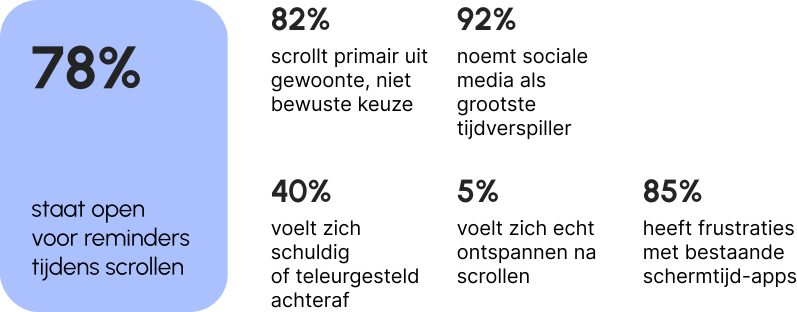
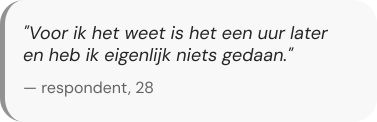
The core: scrolling usually happens automatically. 82% do it out of habit, 68% experience wasted time, and 85% want less screen time. Users do want help, but only if they are not blocked or patronised.
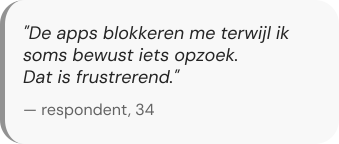
Five themes emerged from our affinity map, including wasted time, frustrations with existing apps, motivation, and reminders on their own terms. Strikingly: people do not just want to "spend less time on their phone", but want to be more mindful of their time, doomscroll less, and, for example, go to sleep on time.
From this, our core problem emerged: not a lack of discipline, but the absence of a natural stopping moment.
That is why our concept focuses on one question:
How do we create a subtle moment of choice before someone automatically starts scrolling?
AI helped in spotting the patterns, after which we manually validated and translated them into design principles.
We started with a proto-persona: an initial hypothesis about our user.
Through a survey of 40 respondents and an in-depth interview, we investigated how people experience their scrolling behaviour and when they are open to help.
The core: scrolling usually happens automatically. 82% do it out of habit, 68% experience wasted time, and 85% want less screen time. Users do want help, but only if they are not blocked or patronised.
Five themes emerged from our affinity map, including wasted time, frustrations with existing apps, motivation, and reminders on their own terms. Strikingly: people do not just want to "spend less time on their phone", but want to be more mindful of their time, doomscroll less, and, for example, go to sleep on time.
From this, our core problem emerged: not a lack of discipline, but the absence of a natural stopping moment.
That is why our concept focuses on one question:
How do we create a subtle moment of choice before someone automatically starts scrolling?
AI helped in spotting the patterns, after which we manually validated and translated them into design principles.
We started with a proto-persona: an initial hypothesis about our user.
Through a survey of 40 respondents and an in-depth interview, we investigated how people experience their scrolling behaviour and when they are open to help.
The core: scrolling usually happens automatically. 82% do it out of habit, 68% experience wasted time, and 85% want less screen time. Users do want help, but only if they are not blocked or patronised.
Five themes emerged from our affinity map, including wasted time, frustrations with existing apps, motivation, and reminders on their own terms. Strikingly: people do not just want to "spend less time on their phone", but want to be more mindful of their time, doomscroll less, and, for example, go to sleep on time.
From this, our core problem emerged: not a lack of discipline, but the absence of a natural stopping moment.
That is why our concept focuses on one question:
How do we create a subtle moment of choice before someone automatically starts scrolling?
AI helped in spotting the patterns, after which we manually validated and translated them into design principles.
The Solution
Based on this insight, we chose Numi: a mobile app featuring a digital buddy that helps users reduce their screen time by creating a friendly, non-patronising moment of choice at exactly that automatic moment, based on autonomy, gentleness, and timing, rather than blocks, guilt, or gamification. Numi is already active from the moment you want to open a time-consuming app. The user can configure which apps Numi should be active on. The tone of voice can also be selected, as our research showed there was no single preference for how people want to be addressed. Therefore, we developed a whole breed of Numis, each with their own character and appearance.
We developed this using brainstorming techniques (mind mapping, Crazy 8, Lotus Blossom) and the MoSCoW method to prioritising features, and subsequently built a working Figma prototype: from onboarding and mascot personalisation to a homepage featuring focus mode, statistics, and settings.
Based on this insight, we chose Numi: a mobile app featuring a digital buddy that helps users reduce their screen time by creating a friendly, non-patronising moment of choice at exactly that automatic moment, based on autonomy, gentleness, and timing, rather than blocks, guilt, or gamification. Numi is already active from the moment you want to open a time-consuming app. The user can configure which apps Numi should be active on. The tone of voice can also be selected, as our research showed there was no single preference for how people want to be addressed. Therefore, we developed a whole breed of Numis, each with their own character and appearance.
We developed this using brainstorming techniques (mind mapping, Crazy 8, Lotus Blossom) and the MoSCoW method to prioritising features, and subsequently built a working Figma prototype: from onboarding and mascot personalisation to a homepage featuring focus mode, statistics, and settings.
Based on this insight, we chose Numi: a mobile app featuring a digital buddy that helps users reduce their screen time by creating a friendly, non-patronising moment of choice at exactly that automatic moment, based on autonomy, gentleness, and timing, rather than blocks, guilt, or gamification. Numi is already active from the moment you want to open a time-consuming app. The user can configure which apps Numi should be active on. The tone of voice can also be selected, as our research showed there was no single preference for how people want to be addressed. Therefore, we developed a whole breed of Numis, each with their own character and appearance.
We developed this using brainstorming techniques (mind mapping, Crazy 8, Lotus Blossom) and the MoSCoW method to prioritising features, and subsequently built a working Figma prototype: from onboarding and mascot personalisation to a homepage featuring focus mode, statistics, and settings.

result
We tested the prototype with users through remote usability testing, tree testing, and card sorting, and structured the insights using the Task-Friction-Fix-Priority Model. This highlighted concrete friction points, such as unclear terminology (the name "Numi" caused confusion), missing swipe hints, and focus mode which users expected in multiple places (both on Home and in Settings). We have already directly addressed a portion of these areas for improvement in subsequent design iterations.
What we learned from this
Research is the foundation of good design choices: user insights, not assumptions, must guide the design. An MVP forces you to make choices: not everything needs to be in the first version, focus on the features that add the most value. Iterating is essential, because a good design doesn't happen in one go, but through designing, testing, and improving.
Microcopy and tone of voice turned out to be a larger part of the user experience than we had previously estimated: small text adjustments and Numi's personality have a significant impact on how users experience the app. And ultimately, UX is not just about a beautiful interface, but primarily about behaviour — the biggest challenge in this project was not designing screens, but creating a friendly and effective choice architecture.
We tested the prototype with users through remote usability testing, tree testing, and card sorting, and structured the insights using the Task-Friction-Fix-Priority Model. This highlighted concrete friction points, such as unclear terminology (the name "Numi" caused confusion), missing swipe hints, and focus mode which users expected in multiple places (both on Home and in Settings). We have already directly addressed a portion of these areas for improvement in subsequent design iterations.
What we learned from this
Research is the foundation of good design choices: user insights, not assumptions, must guide the design. An MVP forces you to make choices: not everything needs to be in the first version, focus on the features that add the most value. Iterating is essential, because a good design doesn't happen in one go, but through designing, testing, and improving.
Microcopy and tone of voice turned out to be a larger part of the user experience than we had previously estimated: small text adjustments and Numi's personality have a significant impact on how users experience the app. And ultimately, UX is not just about a beautiful interface, but primarily about behaviour — the biggest challenge in this project was not designing screens, but creating a friendly and effective choice architecture.
We tested the prototype with users through remote usability testing, tree testing, and card sorting, and structured the insights using the Task-Friction-Fix-Priority Model. This highlighted concrete friction points, such as unclear terminology (the name "Numi" caused confusion), missing swipe hints, and focus mode which users expected in multiple places (both on Home and in Settings). We have already directly addressed a portion of these areas for improvement in subsequent design iterations.
What we learned from this
Research is the foundation of good design choices: user insights, not assumptions, must guide the design. An MVP forces you to make choices: not everything needs to be in the first version, focus on the features that add the most value. Iterating is essential, because a good design doesn't happen in one go, but through designing, testing, and improving.
Microcopy and tone of voice turned out to be a larger part of the user experience than we had previously estimated: small text adjustments and Numi's personality have a significant impact on how users experience the app. And ultimately, UX is not just about a beautiful interface, but primarily about behaviour — the biggest challenge in this project was not designing screens, but creating a friendly and effective choice architecture.